It’s the end of the ‘25-‘26 Academic Year, and I’m trying to take a bit of time to reflect on the semester and the year as a whole. Most of the time, my reflections are only meant for myself, scribbled down in my notebook for me to look back on as I prep for future semester. This year, though, I’m trying to share some portions of those.
There are a lot of things that I’ll be thinking about this summer as I prep for the Fall semester, and I’ve already shared some of that thinking. I have already written about my homework policy on this blog (Iterations of Homework Policies), and I shared some of my thoughts while I was grading the end-of-semester assignments that my students submitted.
Thread of my grading progress (by number of assignments) from now until I finish: 0/14
— Peter Keep (@mathprofpeter.bsky.social) May 8, 2026 at 9:13 AM
For this post I’ll mostly be thinking about only a couple of things: the class materials I’m using, the classroom activities I’ve been using, and the classroom culture that I want to build.
Class Materials
This year I was able to pilot using my own OER text in my calculus courses. I’ve been using my own lecture notes for a while, but a grant I received made it possible to package up and build out my own notes into an actual textbook, called Discover Calculus.
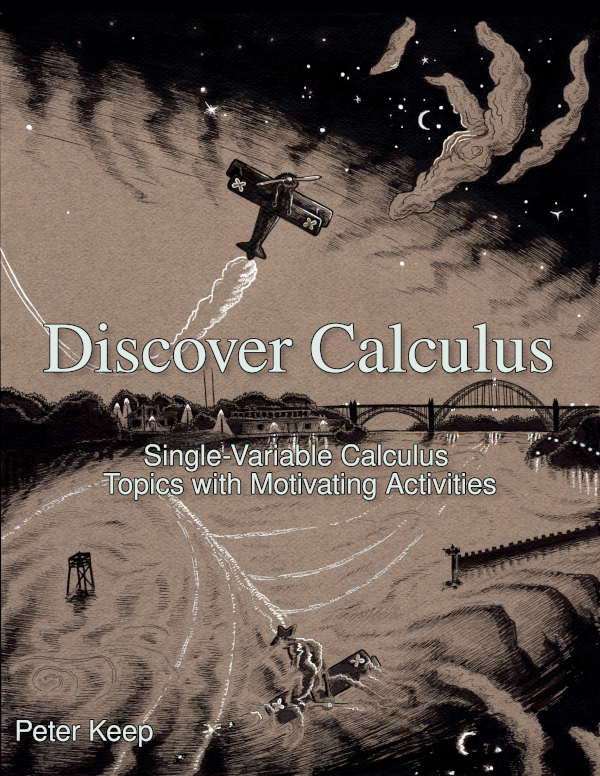 Cover art by acid lich (Lizzie Kodpuak)
I got to spend the year enjoying my own course materials, but I also got to see all of the things I wanted to fix about them. Sure, I caught typos and things like that, but I also got to practice the implementation, interactive elements, and class activities. Every week I got to think about how to tinker with the presentation of definitions or results and how to re-think the description of what we were learning. There was a lot of satisfaction when an idea I had previously but never got to try worked out well in class, but it was also interesting to return to topics to think about.
I’m thinking about course materials pretty broadly this summer, but one thing that I tried to gather some information on was how my students are using the course materials that I’ve built. I asked my students about how they used the text, and what they would change about the course materials:
- Students liked accessing the book online. I host my own website for this, and I link each section in our LMS. I also link things like the activities and any specific interactive thing we look at in class. Students have liked how easy that was to access.
- I printed out a physical copy of a booklet with just the in-class activities in it for each student. This was essentially their course notes. They preferred having that physical copy over a pdf, and students also commented on wanting to add to that physical copy. Some want the whole text, but students also commented on wanting to add just the practice problems (so they can access them easily without the internet) or some summaries of each section. I might try to have each section in their course notes booklet be organized as follows:
- Each section would start with all of the in-class activities that we’ll do.
- After these activities, a summary with the definitions and theorems from that section.
- After this summary, a list of practice problems.
- There were a couple of things that students wanted more of:
- Practice problems. I tried to stay away from the typical big-publisher model where a textbook is really just a repository of problems and a list of definitions and results, but students are expecting more problems to practice. I’ll have to think about how to meaningfully add to my list.
- Videos. They love having access to videos that I recorded, which feels strange to me. I kind of hate my videos. I recorded them in a mad dash in the spring and summer of 2020, so there are plenty of problems with them. They don’t really match the way we talk about these topics in class (I’ve changed and grown in how I talk about these concepts in the last 6 years!), but I also feel like there’s another layer of dissatisfaction with them: they kind of run orthogonal to what my goals of the classroom are. I want students to learn in a community of peers, discussing and discovering together. And I notice that increasing the use of video lectures as a study tool diminishes that, isolating students into their own individual learning bubble. I complained about this in a previous post (My Meeting with a Publisher Rep), and I’m worried about it in this context, too.
- Overall, students liked having free access to course materials that they thought were helpful and interesting. They liked the visuals, the interactive elements, and the focus on class activities as a whole, so in general things are good!
So far, the biggest thing for me to think about (other than the normal amount of tinkering and editing I’m doing this summer) is balancing the effectiveness of printed materials with the limitations on my printing budget.
Class Activities
I mentioned the class activities above, but I’m thinking about them a bit more broadly as well, especially thinking about how they’ve changed throughout the last 2-3 years. Before sitting down to formally write up this textbook, I was still using class activities as the main component of our in-class time. I would bring in a handout to pass out, they would have some instructions to go through, and we would use that to structure our day. Once I sat down to write Discover Calculus, I edited and adapted those activities. I added more to them, made them more interactive, and tried to really carefully construct them as ways to lead into every result we would build. But something that I noticed this year is that, in doing this, is that I tipped the balance of these activities towards tasks and away from discussion.
When I was printing out handouts to bring, almost every one was book-ended with discussion prompts. I might start our class sessions by having students work through a few problems together (I like using compare/contrast examples to showcase some nuance, or problems where they map out how they would approach it to build some intuition), but then they would transition into some pointed discussion prompts that would hopefully prepare us all for whatever topic we were working on that day. Some questions for them to consider, some things to help them see why we were going to be doing what we were going to be doing, etc. And then, somewhere near the end of our class session, there would be another chance to do this. Maybe some prompts to help students summarize what we were thinking about, or return to the original intentions that we set out (instead of staying lost in whatever computations we were doing at the moment), etc.
And I still have some of those scattered throughout the class activities that are in the book! But I have far fewer of them.
This change was completely unintentional: I think I just got excited about adding some very cool activities where students were up to their elbows in problems and examples. And, like I mentioned earlier, students seem to enjoy that part of the class! But want to go back and carefully think about where these discussion prompts are most necessary and helpful, and begin adding them back in. Even if this means we need to remove some time dedicated to the other activities I’ve built, I think a better balance between discussion and doing will be helpful overall to students.
Class Culture
Classroom culture is a thing that I am both proud of and have much to improve on. Every semester, I try to lay a good foundation to help my classroom space to be one where:
- Every person in the room will be valued both in their contributions to the mathematics happening in the room and in as a human being with their own interests, goals, and experiences.
- Learning is a collaborative activity, as is mathematics.
- Computations and calculations are a subset of mathematics, and we will experience doing as much mathematics as possible. We will not limit ourselves to that subset.
- Class and assessment policies should be built to limit the impact of external pressures and obstacles on student success. While this might be impossible to achieve in our current educational system, that won’t stop us from trying.
These are hard to assess. I collect feedback, formally and informally, from students throughout the semester about how they perceive the class culture.
To avoid going too long, I’ll just focus on the first listed goal: making everyone feel valued as a human and also a someone contributing to the math we do.
I made some progress here, but still have lots of work to do. This year, I changed the beginning-of-the-semester introductions: instead of going around the room and introducing themselves, students filled out a small form telling me about themselves, introduced themselves at their tables (normally 5-6 students at a table), and then presented their response to the prompt, “Something that we all have in common that we think makes our group unique.”
From there, I tried to connect with each student at least once in the first few weeks about something they wrote to me on their introduction forms. Sometimes it was about a sport that they liked or some other hobby they engaged with. Sometimes is was addressing some anxiety that they had about the semester. Sometimes is was just commenting on a cool thing they said. I want to try to keep this up throughout the semester more, and be more intentional about connecting with specific students in the middle of the semester.
I also had success in the Spring semester hosting longer office hour slots. I found that in a 2 hour window (instead of my normal 1 hour time slot), more students showed up and I had more time to get to know students individually. I was pretty consistent at making tea during my office hours, which made for an easy invitation to students: come hang out and try the tea I made that day.
I left each semester this year having more specific connections with the students in my class, and they responded positively as well: in the end-of-semester feedback surveys, they reported that they felt respected and felt like they belonged.
I would like to improve on translating this feeling to students with specific reference to their contribution to the mathematics happening in our class. I don’t think it’s enough for a student to feel valued and respected as a person, but to still leave the semester feeling as if they didn’t contribute positively to teaching and learning of mathematics. Mathematics is a human endeavor, and so a student feeling valued as a human in math class should correspond to them feeling valued for their mathematics.
Students talked to me a lot more this year about how they felt in class, and it was clear that I need to do more to make each student feel included in the mathematics we do. The class activities are a fine start to this, but I need to think more carefully about how to ensure that each student is able to contribute individually, and also that students are able to acknowledge their own contributions to the class. I have to do some more thinking about this throughout the summer. How do I best nudge myself to value each students’ mathematics more, and how do I best nudge students to acknowledge their own mathematics throughout the semester?
Anyways, that’s a peek into my reflections on the semester and the year. This small snapshot is just a small bit of the stuff I’ll be thinking about for the next while, but hopefully the most interesting to “think out loud” about.